


Description
MAT-TUNER MAT-1500PRO – HIGH POWER AUTOMATIC ANTENNA TUNER – Upgraded Version
The New Updated MAT-1500Pro offers a new improved, lighter case and adds Yaesu, Icom and Kenwood transmitter interfaces, which can be tuned by transmitter control
The mAT-1500Pro automatic antenna tuner is specially designed for modern high-power transmitters and power amplifiers. It can provide reliable high-performance tuned antenna solutions for land and marine deployments and allows a maximum of 1500W (PEP) RF signals to pass. This is a universal tuner that does not require a control cable to be connected to the transmitter. Users can operate it through the multi-function buttons on the front panel. The tuner has a PTT signal control function. When a tuning cycle is started, the transmitter’s PTT signal is automatically interrupted to the power amplifier.
With 1500W(PEP) RF power handling capability, the Mat-1500 can be used for CW and SSB, over the full 3.5 to 54MHz HF band.
Sufficient Memory Capacity and Quick Tuning – With up to 16,000 data channels for storing LC configuration data, the tuner has an almost unlimited memory capacity. The tuner, using a highly optimised tuning algorithm, new frequencies are tuned in typically less than 5 seconds, previously tuned frequencies are tuned within 100 mS.
High Strength Alloy Housing The mAT-1500 has a high-strength alloy housing, strong and sturdy. The front and rear panels are machined from a complete piece of allow aluminium using a milling process.
The simple operation is the main characteristic of the tuner. There is only one square button on the front panel of the tuner. This button can complete the operation of starting tuning, offline and online functions. It is also an indicator light and can also show the working status of the tuner.
Features
Fast Tuning
High Efficiency
Large-capacity memory
Accurate bridge VSWR inspection
3.5 to 54 MHz
1500W RF power handling
Adapt to various antennas
High-strength alloy housing
Milling production process
Tuning Impedance: 6 to 1000Ω
Specification
Frequency Range: 3.5-54MHz
Power Rating: 1500W PEP and Average
Mode: LSB, USB, CW, FM, FSK, RTTY
Input Impedance: 50Ω
Tuning Impedance: 6 to 1000 Ohms (approximately 10:1 SWR)
Tune Time: Memory 100ms, initial tune 5 sec (typical)
Tune Power: 5-15W, 15W max, excessive power will damage the tuner
Memory Channels: 16,000
Tune Modes: Fully automatic and memory
RF Connector Type: M-type socket, UHF, SO-239
Auxiliaries Receive Antenna Power: 10-15V DC, 1 A max
Operational Temperature: -20 to +60°C
Finish: Black
Enclosure: Aluminium Alloy
Dimensions: 320mm x 240m x 90mm
Weight: 4.5kg
NOTE: For Kenwood radios, you will need the mAT-CI cable
The tuner has three modes indicated by the three lights on the left side of the front panel: “YAESU” Mode, “ICOM/KENWOOD” Mode and “GENERAL” mode. The tuner can automatically determine and match the type of the currently connected transmitter
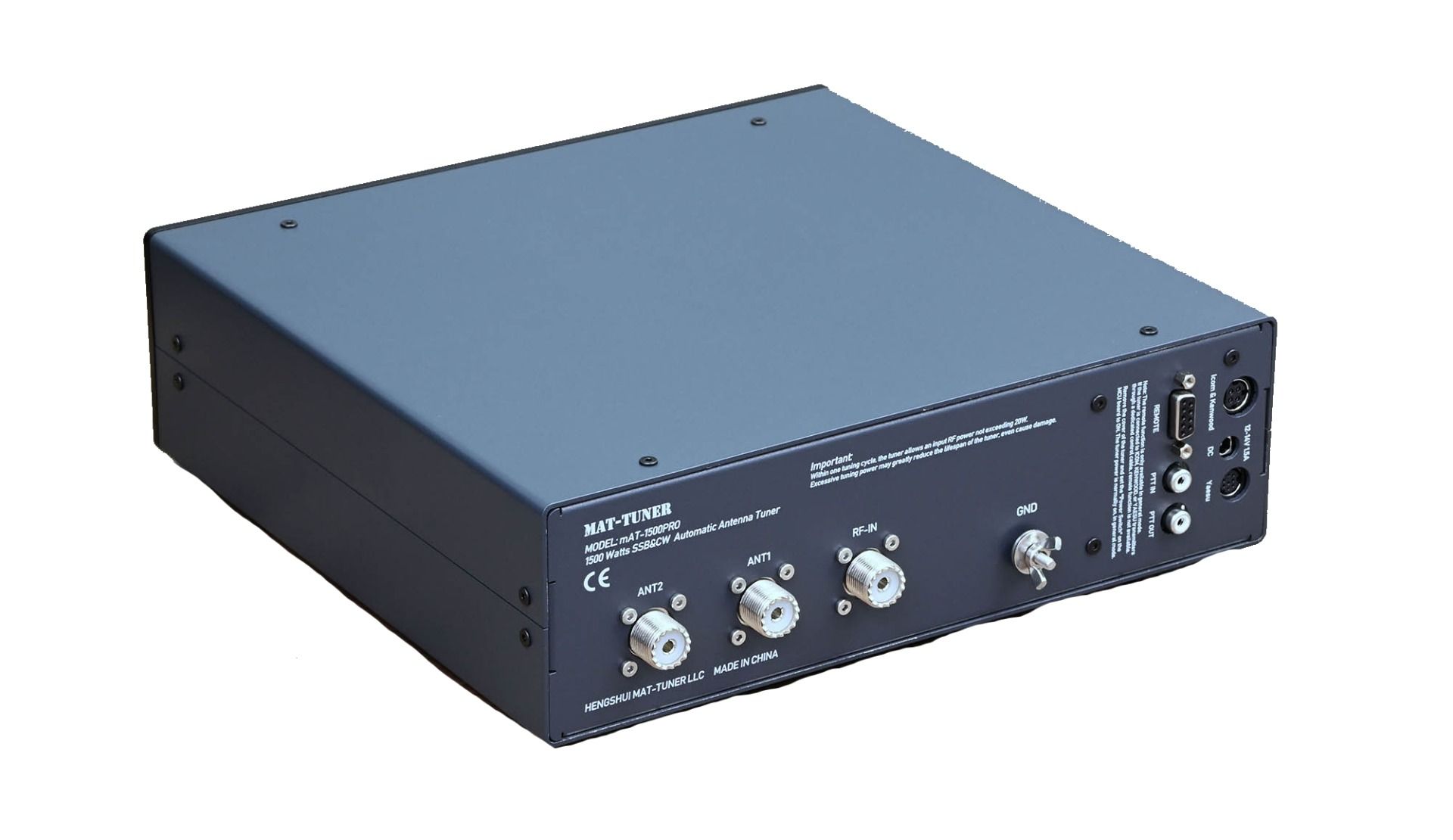
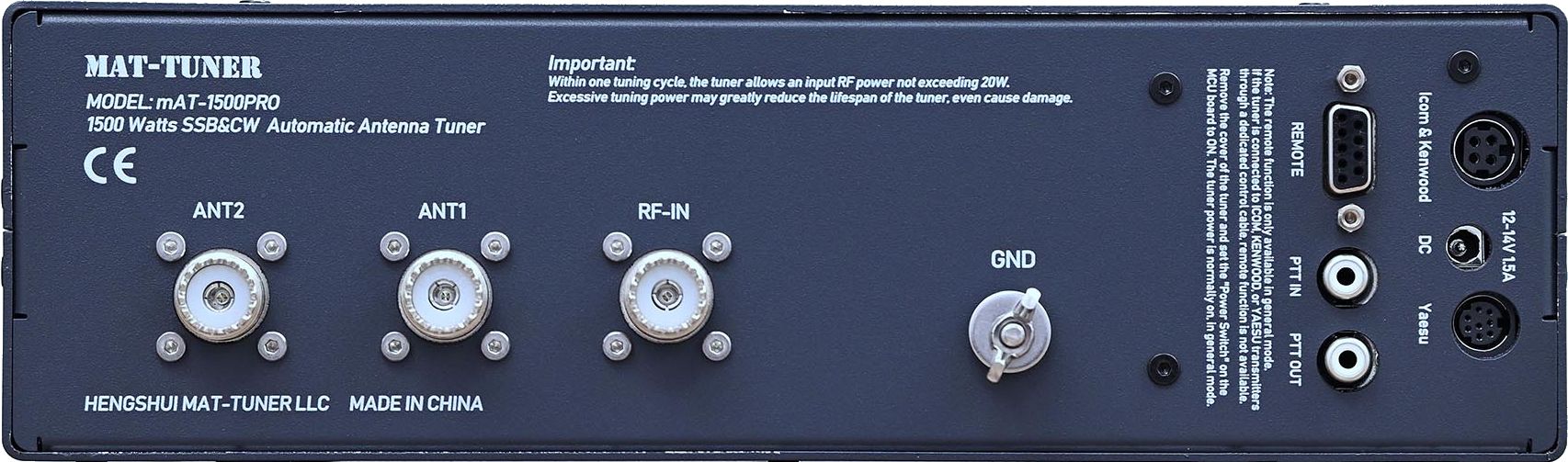
Use the mAT-CI control cable to connect to the “ICOM & KENWOOD” control socket on the rear of the tuner to the “AT” socket on the kenwood transmitter or the “TUNER” socket on the icom radio
1. When the transmitter is turned on, the tuner will automatically set to this mode. The transmitter uses this cable to control and supply power to the tuner
2. If there is a PTT signal cable between your transmitter and amplifier – usually this is a cable with lotus plugs at both ends. If the PTT signal cable is connected, be sure to disconnect it
3. Use an RCA control cable, which comes with the tuner, to connect the “PTT IN” socket of the tuner to the “PTT” signal output of the transmitter. Please read the transmitters manual to make sure you’ve connected to the right PTT socket
4. Use another RCA cable that comes with the tuner to connect the “PTT OUT” socket of the tuner to the PTT input socket of the amplifier
Step 2-4 can cut off the PTT signal of the amplifier during the tuning cycle to make sure it is bypassed and protect the tuner from damage
5. Keep other sockets such as “YAESU” & “DC” Free